
How to Understand Photosynthesis Easily for Class 7
Learn photosynthesis step-by-step for Class 7 CBSE. Understand the process, equation, and key concepts with simple explanations and real examples.
| Topic | Exam Prep |
|---|---|
| Focus | Class 7 Biology |
| Read time | 5 min |
| Words | 1036 |
| Published | 10 Sep 2026 |
| Best for | Parents & students |
What Is Photosynthesis?
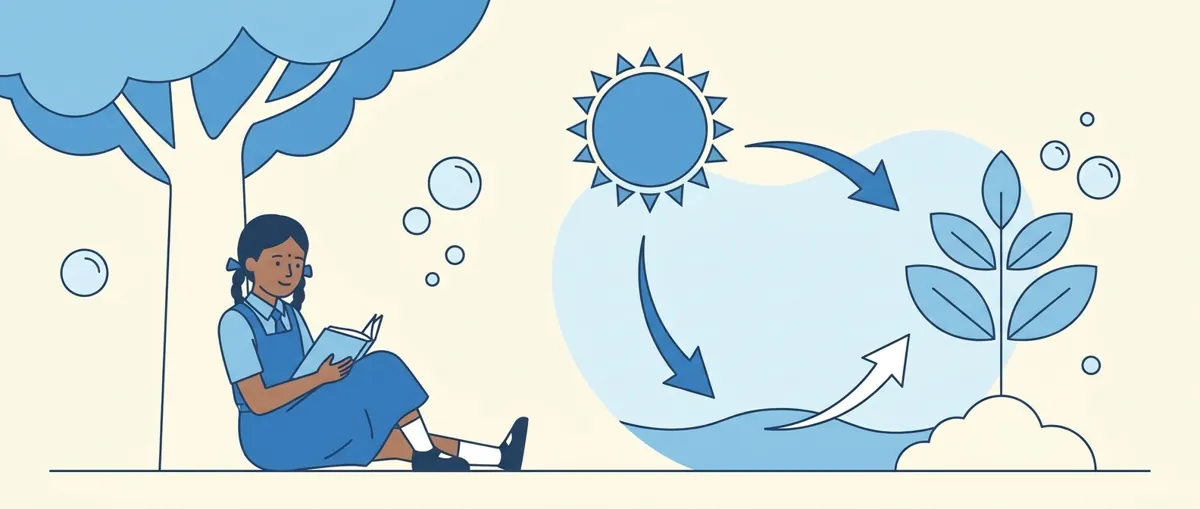
Photosynthesis is the process by which plants use sunlight, water, and carbon dioxide to make their own food (glucose) and release oxygen. It's how plants grow and survive. Think of it as a plant's kitchen—where raw ingredients are transformed into energy.
Why Do Plants Need Photosynthesis?
Unlike animals, plants cannot eat food from outside. They must produce their own energy. Photosynthesis allows plants to convert light energy into chemical energy stored in glucose. This glucose fuels plant growth, reproduction, and all life processes. Without photosynthesis, plants would starve, and we would lose oxygen and food sources.
The Simple Photosynthesis Equation
The basic photosynthesis equation is:
Carbon Dioxide + Water + Sunlight → Glucose + Oxygen
In chemical terms: 6CO₂ + 6H₂O + light energy → C₆H₁₂O₆ + 6O₂
This equation shows that plants take in carbon dioxide from the air and water from the soil, use sunlight as energy, and produce glucose (food) and oxygen (which we breathe).
Where Does Photosynthesis Happen?
The Leaf Structure
Photosynthesis primarily occurs in the leaves of plants. The upper and lower surfaces are covered with a waxy layer called the cuticle, which protects the leaf. Inside, there are layers of cells containing chloroplasts—the tiny structures where photosynthesis actually takes place.
Stomata and Gas Exchange
On the underside of leaves, there are tiny pores called stomata. These open and close to allow carbon dioxide to enter and oxygen to exit. Guard cells control the stomata, opening them during the day when photosynthesis is active and closing them at night to prevent water loss.
Chloroplasts and Chlorophyll
Chloroplasts are the powerhouse of photosynthesis. Inside each chloroplast is a green pigment called chlorophyll. This pigment absorbs light energy, particularly from the blue and red parts of the light spectrum, which is why plants appear green (they reflect green light). The chlorophyll captures sunlight and starts the photosynthesis process.
The Two Main Stages of Photosynthesis
Stage 1: Light-Dependent Reactions (Light Reactions)
These reactions happen in the thylakoids (stacked structures inside chloroplasts) and require sunlight. Chlorophyll absorbs light energy, which splits water molecules into hydrogen and oxygen. The oxygen is released as a byproduct—this is the oxygen we breathe. The hydrogen and energy are used in the next stage. This stage cannot happen without sunlight.
Stage 2: Light-Independent Reactions (Calvin Cycle)
These reactions occur in the stroma (the fluid inside chloroplasts) and do not directly require light, though they depend on products from the light reactions. During this stage, carbon dioxide is converted into glucose using the energy and hydrogen from the light reactions. This glucose is the food that plants use to grow and survive.
What Is Photosynthesis in Simple Words?
Photosynthesis is the process by which plants use sunlight, water, and carbon dioxide to make their own food (glucose) and release oxygen. Imagine a solar panel that not only captures energy but also converts it into food—that's what plants do with photosynthesis. The plant is essentially a living factory powered by the sun.
Key Factors That Affect Photosynthesis
Light Intensity
The brighter the light, the faster photosynthesis occurs—up to a point. Very intense light can damage the plant. This is why plants in shade grow more slowly than those in sunlight.
Carbon Dioxide Concentration
More carbon dioxide means more raw material for the plant to work with. Increased CO₂ speeds up photosynthesis until other factors become limiting.
Temperature
Photosynthesis requires enzymes to function. These work best at moderate temperatures (around 25-35°C). Too cold, and reactions slow down; too hot, and enzymes can be damaged.
Water Availability
Water is a raw material for photosynthesis. Without adequate water, plants cannot photosynthesize efficiently, which is why plants wilt in drought.
Why Is Photosynthesis Important for Life on Earth?
Photosynthesis produces oxygen that all living things breathe and creates glucose that forms the base of most food chains. Plants are primary producers—they create energy from sunlight. Animals eat plants (or other animals that eat plants) to get energy. Without photosynthesis, there would be no oxygen in our atmosphere and no food chain. It's the foundation of almost all life on Earth.
Common Misconceptions About Photosynthesis
Plants Get All Their Food from Soil
Many students think plants absorb food from soil. Actually, plants absorb water and minerals from soil, but they make their own food through photosynthesis using sunlight and carbon dioxide.
Photosynthesis and Respiration Are Opposite
While they seem opposite, they're not exactly. Photosynthesis and respiration are complementary processes—photosynthesis stores energy, and respiration releases it. Both occur in plants.
All Plant Parts Photosynthesize
Only green parts of plants photosynthesize because they contain chlorophyll. Roots, stems without chlorophyll, and flowers don't photosynthesize.
Tips for Understanding Photosynthesis Better
Visualize the Process
Draw diagrams of the leaf structure and label the stomata, chloroplasts, and chlorophyll. Visual learning helps cement the concept in your mind.
Create a Flowchart
Map out the inputs (sunlight, water, CO₂) and outputs (glucose, oxygen). Show how they flow through the two stages.
Use Real Examples
Observe plants around you. Notice how they grow toward light (phototropism) and how they're greener in sunny areas. This reinforces the concept.
Practice with Class 7 Biology MCQs
Regular practice with multiple-choice questions and short-answer problems helps you apply your understanding and prepare for exams.
How EZ Tuitions Can Help
If you're struggling with photosynthesis or other Class 7 Biology concepts, personalized tuition can make a difference. At EZ Tuitions, we offer both online and offline tuition across Delhi NCR (Noida, Gurugram, Delhi) with experienced tutors who break down complex topics into simple, digestible lessons. Our tutors use visual aids, real-world examples, and interactive teaching to ensure concepts stick. Whether you need help with photosynthesis, respiration, or any other CBSE topic, we're here to support your learning journey.
Key Takeaways
- Photosynthesis is how plants make food using sunlight, water, and carbon dioxide.
- It occurs mainly in leaves, specifically in chloroplasts containing chlorophyll.
- The process has two stages: light-dependent reactions (in thylakoids) and light-independent reactions (in stroma).
- Photosynthesis produces glucose (food for plants) and oxygen (for all living things).
- Light, CO₂, temperature, and water all affect the rate of photosynthesis.
- It's the foundation of almost all life on Earth, making it one of the most important biological processes.
Frequently asked questions
- What Is Photosynthesis?
- Photosynthesis is the process by which plants use sunlight, water, and carbon dioxide to make their own food (glucose) and release oxygen. It's how plants grow and survive. Think of it as a plant's kitchen—where raw ingredients are transformed into energy.
- Why Do Plants Need Photosynthesis?
- Unlike animals, plants cannot eat food from outside. They must produce their own energy. Photosynthesis allows plants to convert light energy into chemical energy stored in glucose. This glucose fuels plant growth, reproduction, and all life processes.
- What Is Photosynthesis in Simple Words?
- Photosynthesis is the process by which plants use sunlight, water, and carbon dioxide to make their own food (glucose) and release oxygen. Imagine a solar panel that not only captures energy but also converts it into food—that's what plants do with photosynthesis.
- Why Is Photosynthesis Important for Life on Earth?
- Photosynthesis produces oxygen that all living things breathe and creates glucose that forms the base of most food chains. Plants are primary producers—they create energy from sunlight. Animals eat plants (or other animals that eat plants) to get energy.
- How EZ Tuitions Can Help?
- If you're struggling with photosynthesis or other Class 7 Biology concepts, personalized tuition can make a difference. At EZ Tuitions, we offer both online and offline tuition across Delhi NCR (Noida, Gurugram, Delhi) with experienced tutors who break down complex topics into simple, digestible…
Related articles
- How to Learn Multiplication Tables Fast for Kids: Proven Methods & Tips
- How to Write a Perfect English Essay for School Exams
- How to Solve Quadratic Equations Step by Step for Class 10
- How to Memorise the Periodic Table for CBSE Class 10
- How to Improve Handwriting for Primary School Students: Practical Tips & Exercises
Explore related tuition services: CBSE tuition · home tuition